
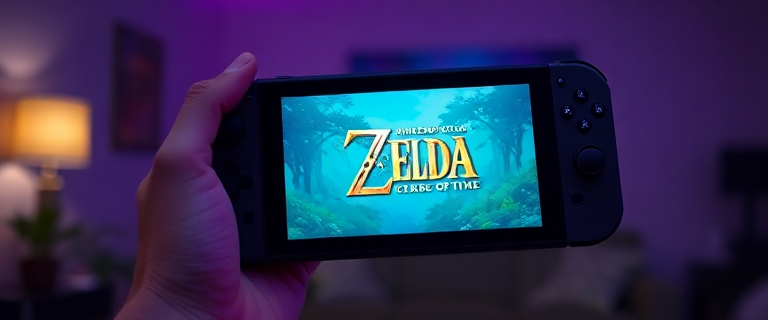
Zelda: Ocarina of Time Remake on Switch 2 reportedly uses FSR 1.0 instead of DLSS
The Switch 2 remake of The Legend of Zelda: Ocarina of Time has become a focal point in the upscaling debate, with preloads surfacing that it does not use Nvidia’s DLSS for upscaling. The evidence centers on third‑party license notices found in version 1.0 that list FidelityFX Super Resolution 1.0 (FSR 1.0) and SMAA for anti‑aliasing, along with a 2021 copyright line attributed to AMD. An entry mentions an optimized FSR’s Edge Adaptive Spatial Upsampling (EASU) implementation for mobiles, and no DLSS appears in the notices. However, a license notice only confirms code that ships with the game; it does not reveal when the upscaler runs or what resolution the base render target uses. Nintendo has not publicly commented on the remake’s upscaling choices. This distinction matters: while the leak is highly indicative, it is not a formal confirmation of runtime behavior.
What FSR 1.0 and EASU mean for this remake
FSR 1.0 is a spatial upscaling technique that enlarges each frame rendered at a lower resolution without borrowing data from previous frames. In practice, that generally means lower cost but cruder preservation of fine detail, with textures such as grass and leaves often showing the most noticeable softening or shimmering artifacts. EASU, short for Edge Adaptive Spatial Upsampling, is the part of FSR 1.0 responsible for how edges are reconstructed during upscaling. That specific implementation dates back to 2021, making it an older solution for a flagship 2026 title. The absence of DLSS in the notices, combined with the presence of FSR 1.0 and EASU, points to a traditional and cost‑conscious upscaling approach rather than a hardware or licensing limitation preventing Nvidia’s tech.
DLSS, by contrast, rebuilds the image with a machine‑learning model and uses data from previous frames, running on the Tensor cores of the Switch 2’s Nvidia‑based hardware. The practical upshot is that DLSS can deliver crisper detail at a fixed render resolution or achieve higher perceived sharpness with lower input resolution. In this case, the absence of a DLSS reference in the license notices does not conclusively prove it isn’t used in any runtime scenario, but it does frame the current understanding of the remake’s upscaling approach.
Fan reactions and the texture of the controversy
Reaction among Nintendo fans has been mixed. Some responders have voiced frustration about missing DLSS, while others point to the quality seen in trailers and previews as proof that the game still looks compelling. The discourse includes pointed statements about the perceived value of DLSS and how it would affect image fidelity, along with counterpoints that praise the remake’s visual direction regardless of upscaling method. Observations from dedicated communities emphasize that, while DLSS would be desirable to many, the final on‑screen result also depends on how the engine renders at native resolution, how well the upscaling holds up in motion, and how effects like foliage render in practice.
Context from other Switch 2 titles
To provide perspective, it’s useful to compare with other Nintendo titles on Switch 2. Donkey Kong Bananza, released in mid‑2025, used the same FSR 1.0 and SMAA combination and showed a docked resolution range of about 1080p to 1200p in practice, according to a technical review. This pattern—FSR 1.0 with SMAA and no DLSS—has been cited as a deliberate choice tied to engine design and the hardware’s original architecture, rather than a hardware limitation of the Switch 2 itself. Mario Kart World also shipped without DLSS, with analysts suggesting engine constraints tied to the first Switch’s design as a contributing factor to why early Switch 2 releases did not use DLSS.
On the other side of the ledger, third‑party studios have demonstrated that Switch 2 hardware can support DLSS. CD Projekt Red confirmed DLSS across all four handheld and docked modes of Cyberpunk 2077 on Switch 2, and Hogwarts Legacy uses a lighter DLSS model to output at 1440p. These examples illustrate that the Switch 2’s Nvidia‑based architecture can, in fact, handle DLSS under the right development conditions, which makes Nintendo’s latter‑day upscaling approach a choice rather than a binding hardware limitation.
Additional technical and launch context
The remake is a full rebuild of the 1998 Nintendo 64 game and is a Switch 2 exclusive. Its first gameplay reveal occurred at a Zelda 40th Anniversary Direct on September 8, and the project adds overhauled visuals, full voice acting, orchestral music, and ocarina gameplay via the console’s microphone. In the United States, digital pricing is $59.99 and physical editions are $69.99. The Switch 2’s display capabilities have become a focal point for fans evaluating how the upscaling will perform on televisions and in handheld mode, particularly now that VRR (Variable Refresh Rate) support in dock mode has been added to the console, providing a smoother tearing‑free experience when rendering at high frame rates on capable displays.
Looking ahead, the central question for buyers isn’t solely whether a game uses DLSS, but how the available upscaling methods interact with the engine, the render resolution, and the target frame rate. The actual render resolution, how the upscaling behaves in docked versus handheld mode, and whether the license notices captured key details accurately will only be known once the game is in players’ hands and independent analyses are published.
What this means for your purchase decision
If DLSS matters to you primarily for sharper image quality at a given performance level, the absence of explicit DLSS in the Zelda remake’s early notices doesn’t automatically doom the visual experience. Nintendo’s approach here appears to align with an engine‑driven, cost‑aware strategy that prioritizes a consistent output across Switch 2 modes. For readers prioritizing the latest AI upscaling technology, the contrast with Cyberpunk 2077 and Hogwarts Legacy on Switch 2 is notable and worth weighing. If DLSS quality is a deciding factor for you, these third‑party examples demonstrate what is possible on the same hardware, underscoring that the Switch 2 can accommodate DLSS when a title is designed to use it. If you care about VRR and how the image stays stable as frame rates vary, the recent VRR addition is an important context that can influence perceived image quality and smoothness in practice.
In sum, the lack of a confirmed DLSS rollout in this remake should be read as a deliberate development choice rather than a hardware constraint. Whether that choice affects your decision depends on how you weigh engine design, development costs, and the anticipated visual result in practice. The real verdict will come with hands‑on testing and frame analysis after launch on November 5.
Notes on the source and caveats for readers
Readers should treat the core takeaway—the apparent absence of DLSS in the license notices observed during a preload—as highly indicative but not definitive. The origin of the information is a prelaunch license leak, and Nintendo has not commented on the remake’s upscaling. As with any such report, the exact runtime behavior can differ once the game is released and further official details emerge. Independent analyses and post‑launch reviews will confirm how the upscaling actually behaves across docked and handheld play, and how the visuals hold up in real game scenarios.
With Nintendo’s history of balancing engine choices, hardware constraints, and development costs, this remains a nuanced story. For fans hungry for perfect DLSS parity, the contrast with third‑party titles that do ship DLSS on Switch 2 provides a useful frame of reference for what the hardware can do when developers choose to implement it.