
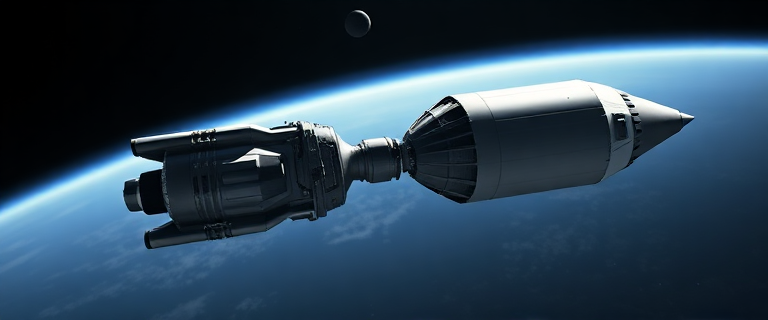
Starship’s orbital refueling for Artemis IV: how SpaceX aims to move the lunar lander to the Moon
As NASA accelerates Artemis toward a crewed lunar landing, the central engineering question is how to top off a lander in orbit. SpaceX’s Starship approach—using a depot in orbit and multiple tanker flights to transfer cryogenic propellants in microgravity—remains the defining, high-risk path. Recent program changes and real-world testing milestones—even as a competitor’s plans face setbacks—shape the timeline and feasibility of demonstrations planned for the 2020s.
The core challenge: orbital refueling in microgravity
Transferring cryogenic propellants in space is fundamentally different from in-air fueling. Starship runs on liquid oxygen and methane, while Blue Origin’s New Glenn will use LOX and liquid hydrogen. In orbit, keeping these cryogenic fuels cold enough to avoid boil-off and managing liquid behavior in microgravity create unique hurdles. The need for in-orbit refueling arises from the rocket equation and the fact that a fully fueled, heavy lunar lander would be impractically expensive to lift all at once. Instead, a lander is sent with near-empty tanks and is topped up in space before headed to the Moon. Recent progress has framed both the promise and the risk of this approach, including a public discussion of possible refueling counts ranging from six to as many as twenty-two tankers, depending on transfer efficiency and boil-off losses.
A concise history of attempts and milestones
Long before SpaceX and Blue Origin tackled orbital transfers, earlier spaceflight efforts explored propellant transfer in orbit. In 1986, the Mir and ISS programs experimented with cargo vehicles transferring propellant, though those efforts used propellants that were not cryogenic. A more direct precursor came with DARPA’s Orbital Express in 2007, which demonstrated autonomous rendezvous, docking, and fluid transfer—but with storable hydrazine, not cryogenic propellants. NASA’s Robotic Refueling Mission 3 (RRM3), launched to the ISS in 2018, achieved long-duration cryogenic storage and a tank-to-tank transfer of liquid methane, the first such attempt in orbit. The sequence ended with a cooler failure in 2019, preventing the transfer demonstration, but it established crucial groundwork for cryogenic fluid management in space.
In March 2024, SpaceX achieved a historic milestone by transferring cryogenic propellant in space within a single Starship vehicle—moving at least 10 metric tons of LOX between two internal tanks during Starship Flight Test 3. This demonstrated that cryogenic transfer is physically possible in orbit, setting an important precedent for later, more complex two-vehicle demonstrations and inter-vehicle transfers.
How fuel flows in space: key concepts and challenges
The process of filling a Starship or a Blue Moon lander in space involves several intertwined problems. First is maintaining the cryogenic state: liquids like LOX and methane boil at extremely low temperatures, so any heat input—sunlight, radiation, or even heat conducted through insulation—causes boil-off. In a depot-based scheme, space hardware must continuously manage this boil-off without wasting propellant. Second is ullage and pressure management: in microgravity, liquids and vapors don’t separate the way they do on Earth, so controlling where the liquid settles and how vapor is vented becomes a delicate balance. Third are the control strategies for moving propellant through the transfer interface, which rely on pressure differentials rather than earth-normal pumping to drive flow. These are the areas where ongoing development is focused as SpaceX and Blue Origin work toward reliable two-vehicle transfers and long-duration storage in orbit.
Recent roadmap shifts shaping the timeline
On February 27, 2026, NASA Administrator Jared Isaacman announced a sweeping restructuring of Artemis, adopting a more incremental approach inspired by Apollo. Under this revised plan, Artemis III becomes an orbital mission rather than a landing, while Artemis IV is designated the first crewed lunar landing. The Lunar Gateway was canceled as part of the overhaul. This changes the urgency and sequencing for orbital refueling demonstrations: a successful two-vehicle transfer and depot strategy becomes a prerequisite for the earliest lunar landing demonstrations, increasing pressure on the SpaceX timetable to prove refueling in time for Artemis IV.
The Artemis program’s new architecture tightens the schedule toward a crewed lunar landing around 2028, with Artemis V following later that year for additional surface operations. The broader Moon base vision continues, but its funding and architecture are now focused on the surface infrastructure and the ascent of crews in a more compact sequence than previously envisioned.
Context on Blue Origin’s path and recent setbacks
Blue Origin faces a different trajectory for its lunar lander. Its initial plan depended on docking with a Lunar Gateway, which has been canceled, creating uncertainty about how Blue Moon would refuel or be certified for crewed flights. In May 2026, Blue Origin experienced a major setback when the New Glenn rocket was destroyed on the pad during a static-fire test, hampering the company’s ability to demonstrate a complete path to Artemis timelines. Despite that setback, Endurance—the Mark 1 variant of Blue Moon—completed thermal vacuum testing at NASA Johnson Space Center in early May 2026, signaling progress on certification milestones even as the pad incident complicates schedules. Blue Origin has stated confidence in continuing to push toward a launch readiness timeline, but operators and observers must account for the broader impact of the explosion on development cadence and competition for Artemis 4 and beyond.
Timeline cadence, lead times, and what the numbers imply
The plan for depot-and-tankers depends on a staged sequence: a propellant depot is launched into LEO, followed by multiple tanker Starships that rendezvous with the depot, transferring propellant over a period that begins more than 200 days before the crew launch. NASA is targeting more than 10 tanker flights, at roughly six-day intervals, to fully stock the depot. The path then calls for the Starship HLS to top off before the crew launch to the Moon. This cadence means a long lead time and a dense launch tempo, both of which amplify risks from boil-off losses and transfer inefficiencies.
Public discussions have shown a wide range of estimated tanker counts: some estimates, supported by early Aerospace Safety Advisory Panel statements, suggested as many as 22 refuelings, while SpaceX and its proponents have cited six to eight as a more optimistic range. TheReality of a four-launch or even twenty-two-launch plan hinges on boil-off management, transfer efficiency, and actual demonstration results in two-vehicle transfers, not just the orbital staging architecture.
What the orbital demonstration schedule looks like—and how dates have shifted
The first orbital refueling demonstration has faced scheduling slips. It was originally planned for March 2025, then delayed to March 2026, and has now been carried forward into 2026 with no firm date publicly announced, per NASA and oversight reporting. This history of shifts underlines the difficulty of synchronizing docking, temperature control, and fluid transfer in two independent spacecraft in microgravity, all while ensuring that the longer-term refueling and crewed landing demonstrations stay on a believable timeline.
What matters for decision-making: trajectory, risk, and credibility
For decision-support on Artemis timing and contractor readiness, the key is to weigh demonstrated progress against remaining technical hurdles. SpaceX’s internal cryogenic transfer demonstration in 2024 showed that cryogenic transfer is physically possible in space, providing a credible proof point for the feasibility of inter-vehicle fueling. The next critical step—two separate Starships docking and transferring fuel between vehicles in space—remains the most important milestone to verify. The delay history, coupled with oversight findings that cryogenic fluid management remains a top challenge for both SpaceX and Blue Origin, reinforces the need for cautious, evidence-based scheduling rather than optimistic projections alone. The restructuring of Artemis, which places Artemis III in an orbital test role and elevates Artemis IV as the first lunar landing, adds urgency to completing the refueling demonstrations in time for a credible 2028 landing date.
Looking ahead: implications for Artemis, technology, and the Moon
Cracking the orbital refueling challenge would decouple deep-space capability from single-launch mass, enabling the Moon, Mars, and other destinations to become reachable with a modular logistics approach in low Earth orbit. As Artemis 2 demonstrated the feasibility of crewed lunar orbits, the next leg—proof of dependable transfer between orbiter and lander—remains the pivotal barrier to rapid, repeatable lunar landings. If SpaceX’s two-vehicle transfer proves viable, the Artemis program could advance toward its planned cadence and surface operations; if not, Blue Origin and other approaches may gain time, but with a more uncertain timeline. The path to a sustained lunar presence will depend on a combination of proven cryogenic fluid management, dependable depot operations in LEO, and the ability to scale tanker flights while minimizing boil-off and losses.