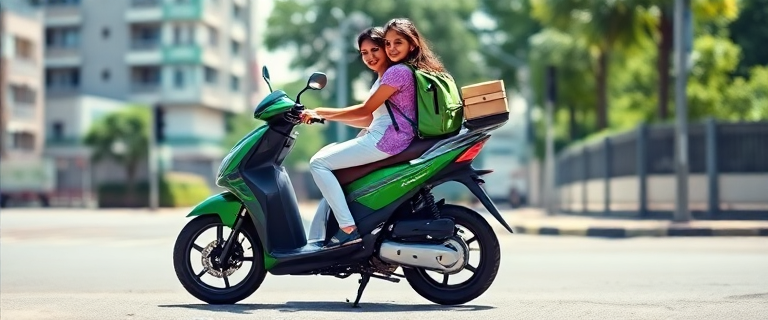
Variants at a glance: power, range, and price
The Wave family starts with an entry model, Wave S, powered by a 2.2 kWh battery. This base variant delivers an IDC range of 110 km at up to 75 km/h, and a 0–40 km/h time of about 4 seconds. The 2.2 kWh Wave S also offers charging convenience, with a 0–80% fast-charge time listed at roughly 1 hour and 10 minutes in the available specifications. The ex-showroom price for the Wave S 2.2 kWh in Bengaluru is ₹1,09,999.
Moving up, the Wave S 2.7 kWh options (EBN and TFT variants) use a 2.7 kWh battery and raise the IDC range to 132 km, with top speed at 90 km/h. These variants share a 6.4 kW motor and are priced at ₹1,39,999 (EBN) and ₹1,49,999 (TFT) respectively.
The Wave S 3.7 kWh variants (EBN and TFT) continue the progression, delivering 171 km IDC range at 90 km/h. They are priced at ₹1,59,999 (EBN) and ₹1,74,999 (TFT).
The Wave Plus 5 kWh TFT variant tops the range at 243 km IDC with a 90 km/h top speed, priced at ₹1,89,999 ex-showroom Bengaluru. Across the board, the Wave lineup uses a 6.4 kW motor on most mid-to-top variants, while the base 2.2 kWh pack uses a smaller 4.5 kW unit.
All variants share practical features aimed at everyday use, including a large boot and rider conveniences. The Wave line also distinguishes itself with riding modes and safety features that vary by trim, such as GripSense traction control on higher trims and modes like Ride, Eco, EcoX, and Sport on select models.
In short, you can match a Wave to your needs from a compact entry scooter to a long-range family carry-all, with price and capability increasing together as battery size grows.
Real-world range and how to interpret IDC/ARAI figures
Manufacturer-claimed IDC ranges are based on standardized laboratory test cycles. They provide a baseline for comparison but do not guarantee real-world performance. Real-world range depends on factors such as speed, terrain, load, weather, and riding style. In practice, customers should expect variability beyond the IDC figures, especially in urban stop-and-go use. It’s helpful to think of IDC as a “range potential” rather than a fixed city mileage promise. For context, the Wave base variant is listed with 110 km IDC, while higher-capacity batteries extend the figure up to 243 km in the top-end Wave Plus 5 kWh variant. At the same time, ARAI-claimed ranges and IDC figures can appear alongside each other in the market, and buyers should interpret them with the understanding that they reflect testing conditions rather than guaranteed daily experience.
For buyers, the key takeaway is clear: if you routinely travel longer distances or carry a full payload, you’ll naturally lean toward the higher-capacity Wave variants. If your daily riding is shorter and you mainly need urban efficiency, the 2.2 kWh or 2.7 kWh variants offer a balanced mix of range, speed, and cost. Prices and exact specs vary by variant and market, so verify the current figures at the time of purchase.
Charging and charging times: what you need to know
All Wave variants are designed for home charging using the supplied or optional charger, with the charging port located on the apron for easy access. The 2.2 kWh base model lists a 0–80% fast-charge time of about 1 hour 10 minutes. Times for the larger 2.7 kWh, 3.7 kWh, and 5 kWh packs are not uniformly published across sources, so official times should be confirmed for each variant when you’re deciding which pack to buy.
In practice, home charging remains the most convenient option for everyday use, while fast charging can significantly cut down charging downtime on longer trips. It’s worth noting that charging efficiency and losses can vary with local electricity tariffs and charger quality, so your monthly running costs can differ from published estimates.
Performance, practicality, and family-ready design
The Wave lineup uses a 6.4 kW motor on mid-to-top variants, with the base Wave S 2.2 kWh variant using a 4.5 kW motor. The 0–40 km/h acceleration figures vary by variant: some Wave models achieve 0–40 in about 3.3 seconds, while the base S is around 4 seconds. The Wave family’s chassis rides on 12-inch wheels with a telescopic front fork and preload-adjustable twin rear shocks. Braking consists of a front disc and rear drum setup, delivering a balanced urban braking experience. The Wave offers 70 litres of boot space and a seat length of 920 mm for comfortable two-up riding and everyday shopping trips, with a ground clearance around 175 mm.
GripSense traction control is available on higher trims, contributing to safer handling in low-traction conditions. The Wave targets family use with a long seat and substantial storage, while top variants deliver higher top speeds and longer range through larger batteries and more powerful motors.
Other practical touches include a pillion-friendly design with a sari guard, pillion foot pegs, grab rail, and a boot-light for easier loading after dark. The design emphasizes usability for everyday family errands and longer weekend rides alike.
Load, payload, and everyday practicality for a family scooter
The Wave is positioned as a family-oriented scooter with a load-carrying capacity of 150 kg. The long 920 mm seat and 70 L boot are designed to accommodate daily groceries or a weekend shopping haul, while pillion provisions—such as a dedicated pillion seat, rear footpegs, and a grab rail—support two-up riding. The sari guard and durable finish help ensure practicality in common, real-world use.
Warranty and ownership: what’s covered
Warranty terms for the Wave cover several components, with distinctions between vehicle, battery, motor, and charger. A typical setup lists a vehicle warranty of 3 years or 30,000 km, a battery warranty of 3 years or 30,000 km, and a motor warranty of 3 years or 30,000 km. Charger warranty is commonly 2 years. An extended warranty option exists, for 5 years or 50,000 km, and roadside assistance is available as an add-on.
Prices shown on the page are ex-showroom figures for Bengaluru and should be reconfirmed before purchase, as terms may vary by market and over time. If you’re planning ownership around the battery and motor reliability, the component-level warranty details above help you understand where protection applies and where it may be extended.
Running costs: a quick budgeting reference
Running costs for electric scooters depend on local electricity tariffs and charging efficiency. Third-party estimates suggest an average of around ₹0.20 per kilometer, which translates to roughly ₹100 per 500 kilometers of riding, assuming typical usage. Actual costs will vary with your tariff and charging losses, so treat ₹0.20/km as a reasonable starting point rather than a fixed guarantee.
Colors and test rides
The Wave is offered in six colours: Pearl White, Polar Blue, Forest Green, Coral Red, Twilight Black, and Dolphin Grey. Availability by variant and market may vary. Test rides are typically available through Simple Energy’s official channels and participating dealers; readers are encouraged to book a test ride to experience fit, comfort, and ride quality before committing to a variant.
How to decide which Wave variant is right for you
Choose based on your daily distance, payload needs, and how you value range versus cost. If your daily commute is short and you mostly run around town, the base Wave S 2.2 kWh offers a compact, economical option with a 110 km IDC range and a 75 km/h top speed. If you regularly travel longer distances or carry heavier loads, the Wave S 2.7 kWh variants or the Wave 3.7 kWh variants extend range to 132–171 km IDC and maintain higher top speeds. For maximum range and long weekend rides, the Wave Plus with a 5 kWh pack delivers up to 243 km IDC and 90 km/h top speed, at the top end of the price range.
Importantly, compare not just price and range, but boot space (70 L), seat length (920 mm), payload rating (150 kg), and available safety features like GripSense and Crawl/Hill Hold/Limp Home modes on higher trims. If you cross-shop with rivals like Ather Rizta, Bajaj Chetak, TVS iQube, or Ola S1 X/Z, weigh the Wave’s differentiator—a 6.4 kW motor across most variants and a very large boot—against rival boot sizes, price points, and TCO over three years.
Finally, remember that IDC/ARAI figures are testing-cycle values. Real-world range will vary with speed, terrain, load, weather, and riding style, so consider your typical use case and factor in some margin for variations when budgeting and test-riding.
Rivals and how the Wave stacks up (quick view)
In the price band, the Wave sits alongside models such as TVS Orbiter, Bajaj Chetak, Ather Rizta, Ola S1 X and S1 Z. The Wave’s spread—from 2.2 kWh up to 5 kWh packs—gives it flexibility to compete on range and price, with the Wave Plus 5 kWh variant offering the strongest range at 243 km IDC and a 90 km/h top speed. The 70 L boot and 150 kg load rating address family practicality, positioning the Wave as a compelling choice for buyers who prioritise boot space and long-seat comfort in a family scooter context. Prices and exact specs are date-sensitive, so confirm the current figures before buying.
Colors, availability, and how to proceed
Six colour options are available, though offerings may vary by variant and market. If you’re considering a test ride or want to lock in pricing, visit Simple Energy’s official site or your local dealer for the latest options and scheduling. For decision help, use the Wave’s variant map to align your daily riding pattern with the appropriate battery size and feature set.