The End of Oak Street Review
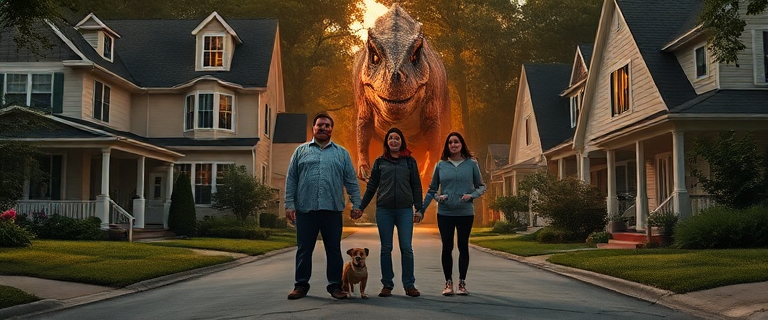
The End of Oak Street blends a deliberate 1980s cinema sensibility with dinosaur spectacle and a family survival story, all wrapped in a PG‑13 thriller framework. David Robert Mitchell directs and wrote the screenplay, supported by a high‑powered producing slate that reads like a reunion of contemporary genre talent. The film invites viewers into a suburban dream that becomes a prehistoric nightmare, released theatrically on August 14, 2026 and streaming on September 28, 2026. With a production budget around $80 million, it sits in the mid‑sized range for genre releases from Warner Bros. Pictures in collaboration with Bad Robot, Good Fear Content, and Jackson Pictures. The running time is 1 hour 39 minutes, and the PG‑13 rating warns of strong language, bloody imagery, some violent content, and suggestive material.
Plot Overview
The End of Oak Street asks a stark question: what if your neighborhood was suddenly ripped from the map and dropped into the Mesozoic era? The Platt family—Greg, Denise, Audrey, and Brian—are forced into a harrowing survival journey after a mysterious cosmic event transports their seemingly ordinary suburban block to a prehistoric landscape. The central tension is a test of family unity: in a crisis where food, water, modern conveniences, and trusted neighbors vanish, the bond that holds them together becomes their most reliable resource.
As the plot unfolds, the Platts confront a world where danger lurks at every turn—from stampeding carnivores to the enigmatic mechanics of time travel that seem to pull them toward an elusive return. Early tensions within the family surface: Greg’s buoyant optimism clashes with Denise’s practical realism, while Audrey, a curious teen, and Brian, a perceptive preteen, mirror the clash between hope and fear. A pivotal arc follows their efforts to locate their missing children, guiding them toward a mysterious wormhole. The portal offers a possible escape, but it also deepens questions about time, memory, and responsibility as the family faces consequences across shifting timelines.
As the narrative progresses, the Platts endure a sequence of ordeals—dinosaur encounters, close calls, and revelations about the nature of their blip in time. A two‑year jump in the timeline reshapes their reality, and the family reconstitutes life in a reconfigured world. The ending leaves some ambiguity about the fates of those left behind in alternate timelines, blending action with emotional resonance to underscore our themes of resilience, memory, and the ethics of sacrifice under existential pressure.
Characters & Cast
The emotional core centers on the Platt family, with
- Greg portrayed by Ewan McGregor as a well‑meaning father whose optimism sometimes collides with reality.
- Denise, played by Anne Hathaway, is a grounded, pragmatic mother who channels determination into navigating escalating danger.
- Audrey is brought to life by Maisy Stella, offering a teenage lens on crisis,
- Brian, played by Christian Convery, adds perceptive, emotionally attuned perspective.
Supporting figures include Starbuck the family dog and neighbor Jeanette, portrayed by Jordan Alexa Davis. The ensemble’s chemistry—especially Hathaway and McGregor as a fractured couple—helps ground the film’s more fantastical elements in credible human stakes.
Critics frequently highlight the cast as a strength, noting credible fear responses and strong on‑screen rapport that keep the family’s stakes relatable. The creature design leans into a spectrum of prehistoric threats, with feathered dinosaurs reflecting current paleontological understanding and with large predators like Allosaurus and brontosauruses adding variety to the danger the family faces.
Production & Technical Details
The End of Oak Street unfolds under the artistic leadership of director‑writer David Robert Mitchell, whose work blends genre suspense with emotionally grounded storytelling. Mitchell co‑writes the screenplay and collaborates with a producing team that includes J.J. Abrams, Hannah Minghella, Jon Cohen, Matt Jackson, and Tommy Harper. The production is carried by Bad Robot, Good Fear Content, and Jackson Pictures, with Warner Bros. Pictures serving as distributor to bring the film to a broad audience.
Technically, the production balances practical effects with CGI to create a tactile prehistoric world. Feathered dinosaurs align with current scientific understanding, while other creatures are rendered through a mix of practical effects and digital techniques to support the narrative’s sense of scale and danger. Michael Giacchino provides a score that nods to 1980s cinema while delivering modern orchestration to heighten family moments and perilous sequences. The release follows a two‑phase plan: a theatrical launch on August 14, 2026, followed by streaming on September 28, 2026. At 1 hour 39 minutes, the film maintains brisk pacing that blends suspense with character development. The PG‑13 rating notes strong language, bloody imagery, violent content, and suggestive material, signaling a mature approach that remains anchored in family bonds and shared peril.
The $80 million budget places the movie in a middle tier for contemporary dinosaur thrillers, enabling ambitious creature design and period‑accurate set dressing without escalating into blockbuster excess. The collaboration among major studios and production houses reflects a coordinated effort to deliver a high‑quality, character‑driven genre piece with broad audience appeal.
Visual & Thematic Style
The End of Oak Street embraces a dedicated 1980s homage while weaving in contemporary questions about science, family, and fear. The opening block party on Oak Street is crafted to evoke Spielbergian warmth and community, providing a tonal contrast to the prehistoric danger that erupts. This stylistic choice anchors the film emotionally, reminding viewers that the threat extends beyond the dinosaurs to the fragility of everyday life and the relationships that shelter us.
Dinosaur design is a focal point. The film features feathered species in line with current paleontology, complemented by large predators such as Allosaurus and brontosauruses to create narrative variety and testing of the family’s resourcefulness. The production design emphasizes tactile, period‑accurate environments, with practical effects used where feasible and CGI deployed to stage high‑stakes chases and large‑scale encounters. Giacchino’s score reinforces the 1980s sensibility while underscoring pivotal family moments and moments of danger.
Humor and clear communication help the family cope, providing relief amid danger and offering opportunities for growth. Dialogue, shared silences, and small acts of compassion enrich the story beyond pure action, yielding a balance between survival horror and intimate family drama. Some critics note that tonal shifts can feel uneven depending on audience expectations, but many readers respond to the film’s emotional throughline about togetherness in the face of chaos.
Strengths Highlighted by Critics
Critics consistently praise the film’s strong ensemble, with Hathaway and McGregor delivering emotionally nuanced performances that anchor the story. The Platt children, Maisy Stella and Christian Convery, receive frequent commendation for their chemistry and credible fear responses, keeping the family’s stakes relatable. The visual design, especially the feathered dinosaur depictions, is repeatedly cited as a standout, supported by thoughtful sound design and Giacchino’s score that immerses audiences in danger without relying solely on gore. Overall, the emphasis on family dynamics as the essential survival toolkit resonates with audiences who value character‑driven thrillers.
Criticisms & Weaknesses
Several reviewers note pacing inconsistencies, with stretches that linger on setup before escalating into action. Some critics also point to a tonal balance that can feel uneven between family drama and survival horror, and some describe the ending as abrupt or unsatisfying given the wormhole and blip mechanics. The violence and mature content are topics of debate, with discussions about how faith and religious themes are portrayed in the narrative. A few production choices, including certain green‑screen moments, have been highlighted as less convincing against the otherwise nostalgic, practical aesthetic.
Comparisons to Similar Films
In the landscape of dinosaur thrillers and 1980s‑inspired cinema, The End of Oak Street sits between the adventurous energy of Jurassic Park‑style adventures and the more intimate, psychological terrain explored in It Follows. The film leans toward a survival horror sensibility that prioritizes family dynamics and character conflict over sprawling chase sequences. Compared with Jurassic Park’s sense of awe, Oak Street emphasizes danger and the emotional costs of survival when time itself becomes a hazard. Viewers who enjoy tense, character‑driven thrillers with dinosaur spectacle are likely to find it a compelling blend, even as some audiences may crave a tighter narrative focus.
Audience Takeaway & Recommendation
The End of Oak Street will appeal most to families and adults who enjoy a blend of nostalgia, creature features, and moral questions about communication and resilience. Its 1980s homage, strong performances, and distinctive dinosaur design make it accessible for viewers seeking atmosphere and emotional depth alongside suspense. Those who appreciate a balance of period vibe and contemporary sensitivity will find appeal in the film’s mood, unity‑driven survival, and design fidelity in the dinosaur sequences.
Conversely, audiences seeking a perfectly cohesive narrative or a strictly family‑friendly tone may experience pacing unevenness or an ending that doesn’t fully satisfy. Viewers looking for a straightforward creature feature may feel the film asks for more investment than some summer releases demand.
For further context on production and marketing, Warner Bros. Pictures provides official information and materials tied to The End of Oak Street, highlighting the collaboration with Bad Robot and the project’s creative leadership.
External link for more details: Warner Bros. Pictures — The End of Oak Street