
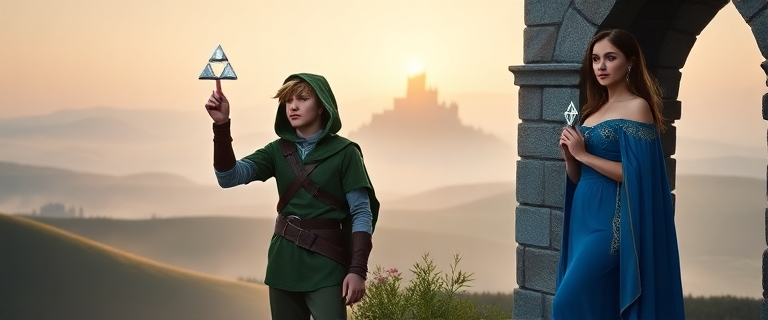
The Legend of Zelda: A Broad Overview of the Franchise
The Legend of Zelda is a long-running action-adventure series from Nintendo that centers on the cycles of heroism, peril, and discovery in the land of Hyrule. Across more than three decades, the games have evolved from tightly designed top-down quests to expansive open-world experiences, while building a rich lore around three central figures—Link, Zelda, and Ganon—and the relic called the Triforce. The series is renowned for its inventive gameplay, memorable music, and a pervasive sense of exploration and puzzle-solving. As of March 2025, the franchise has sold about 156.28 million copies, underscoring its position as one of gaming’s most enduring and influential brands.
Current status and upcoming projects
New Zelda projects and cross-media events have continued to appear alongside ongoing remastering and film/concert announcements. A live-action Legend of Zelda film is in development as a cross-studio collaboration between Nintendo and Sony, with Wes Ball attached to direct and production activity advancing in New Zealand. Release timing has shifted over time; the film has been positioned for a 2027 release window, with official updates indicating a May 7, 2027 date in some reports. Filming reportedly began in New Zealand in late 2025 and continued into 2026.
On the game side, notable cross-media entries and re-releases include the Hyrule Warriors line. Hyrule Warriors: Age of Calamity (a spin-off set before Breath of the Wild) has established its own narrative place, while Hyrule Warriors: Age of Imprisonment (a Switch 2-era title) released in November 2025. The console ecosystem also features Switch 2 editions tied to major titles: Breath of the Wild and Tears of the Kingdom, each receiving a Switch 2 edition. A 40th Anniversary Edition bundle for the Switch 2—highlighting The Legend of Zelda: Ocarina of Time—was scheduled for release in late 2026. An Ocarina of Time remake has been the subject of extensive reporting, but as of this update no definitive worldwide release date has been confirmed beyond general industry speculation.
Additionally, 2027 concert tours celebrating the Zelda music repertoire and other anniversary-related products are being rolled out, with live performances and streaming-access options expanding through official Nintendo channels, including Nintendo Music streaming for Switch Online subscribers, which carries a growing library of Zelda soundtracks. These developments reflect a broader cross-media strategy that reinforces Zelda’s cultural footprint without collapsing the franchise’s core gaming focus.
For readers seeking a concise snapshot of current and upcoming items, this section distinguishes confirmed facts from rumors and avoids burying concrete announcements within speculative language.
Timeline and canon: understanding the three official branches
Official lore places The Legend of Zelda on a branching chronology introduced in Hyrule Historia. The three canonical branches are the Hero is Defeated route, the Child Era, and the Adult Era. The series’ most recent official placements position Breath of the Wild after many prior installments, but without declaring a single branch for its placement, inviting interpretation within the established framework. Echoes of Wisdom, released in 2024, sits after Tri Force Heroes and before the original Legend of Zelda in the broader timeline. Hyrule Warriors: Age of Calamity is treated as a canonical spin-off that diverges from the backstory of Breath of the Wild and is considered non-canonical in its key backstory implications. Breath of the Wild’s sequel, Tears of the Kingdom (2023), is depicted as a direct continuation of the BotW arc, while Echoes of Wisdom expands the timeline further in a way that remains within the official framework. These placements reflect the franchise’s mature handling of canon, where some titles function as alternate takes rather than strict replacements of existing lore.
To avoid confusion, a simple way to think about it is that the official timeline splits after Ocarina of Time into three routes, and that later entries like Breath of the Wild and Tears of the Kingdom sit within that broader multi-branch structure. The Downfall branch is not created by Link’s time travel, and some later entries sit in ambiguous placements that the official materials treat as open to interpretation. A short, reader-friendly takeaway is that the three branches provide the backbone for the series’ evolving history, while individual games refine or reinterpret specifics within that framework.
Goddesses, Triforce, and how the Triforce works
A core myth of the series describes three goddesses—Din, Nayru, and Farore—who entrust the world to the Triforce, a relic capable of granting any wish. The Triforce embodies three virtues: Power, Wisdom, and Courage. An important correction to the franchise’s lore is that the goddess-to-virtue mapping is Din with Power, Nayru with Wisdom, and Farore with Courage. If a person lacks a balanced heart, the Triforce splits into its three components, with each part seeking a bearer who embodies the corresponding virtue. This unbalanced dynamic is central to how the relic’s power interacts with the world across the games. In Skyward Sword, the Triforce is connected to the origin story of Hyrule and to the Master Sword’s creation, underscoring its pivotal role in the broader mythos. Zelda’s various incarnations have often been contact points with the Triforce of Wisdom, tying her lineage to the relic’s governance across eras.
In practical terms for readers: this mythos explains why the world’s fate often hinges on the appearance and actions of Link, Zelda, and the Triforce. The enduring question of who embodies which virtue shapes the stakes of each game and frames the reader’s understanding of the series’ recurring conflict with Ganon and the forces that threaten Hyrule.
Key figures: Link, Zelda, and Ganon
Link is the primary playable hero across most mainline titles, typically portrayed as a courageous Hylian who wields a variety of weapons and tools to overcome puzzles, enemies, and exploration challenges. Zelda is the titular character whose role varies by game; she is the mortal incarnation of the goddess Hylia in some eras, bearer of wisdom, and in certain titles a direct combatant or ally who uses magic, bows, or other artifacts. Ganon (also known as Ganondorf in his Gerudo form) is the series’ principal antagonist, driven by the desire to seize the Triforce and reshape the world to his will. In different entries, Zelda’s alter egos—Sheik, Tetra, and others—provide alternate identities that support Link’s quest or redefine the hero’s relationships to the land and its lore. The Triforce’s three components—Power, Wisdom, and Courage—serve as the symbolic engines behind the series’ conflicts and the destinies of its three main characters.
Beyond these central figures, the franchise features a broad cast across Hylians, Sheikah, Gorons, Zoras, and other races, all contributing to Hyrule’s lore and the games’ interwoven histories. The dynamic between Link’s silence, Zelda’s wisdom, and Ganon’s power remains a defining thread through the franchise’s evolution.
Major entries and their contributions
The Legend of Zelda (1986) introduced the core conceits: an open overworld connected to dungeon-based puzzles, a battery-backed save function, and a steady cadence of item-driven exploration. The Adventure of Link (1987) experimented with side-scrolling design and introduced RPG-like experience progression. A Link to the Past (1991) popularized the Dark World conceit and broadened the franchise’s narrative scope, while Link’s Awakening (1993) brought Zelda to handheld systems and set the template for portable entries. Ocarina of Time (1998) is widely credited with defining 3D action-adventure design, introducing precise target-locking and contextual button usage that shaped years of game design. Majora’s Mask (2000) experimented with time mechanics and a darker atmosphere, while Oracle of Seasons and Oracle of Ages (2001) linked together through a shared puzzle framework. Four Swords (2002) introduced multiplayer Zelda gameplay, and The Wind Waker (2002) popularized cel-shaded visuals and sailing-based exploration. Twilight Princess (2006) blended realism with a darker tone and expanded movement mechanics, and Phantom Hourglass (2007) introduced stylized dual-screen gameplay on the DS. Spirit Tracks (2009) built on the Phantom Hourglass engine and added train-based traversal and possession mechanics. Skyward Sword (2011) reintroduced motion-based swordplay as a central mechanic, and laid groundwork for the series’ origin story with the Master Sword’s creation. A Link Between Worlds (2013) reimagined non-linear dungeon progression and item renting, while Breath of the Wild (2017) redefined open-world design with experimental physics and chemistry systems and a narrative that rewards experimentation. Tears of the Kingdom (2023) expands on BotW’s world with new construction and time-manipulation abilities, and Echoes of Wisdom (2024) places Zelda in the lead and broadens the series’ puzzle-solving vocabulary with the Tri Rod and echo mechanics.
For readers seeking a concise sense of where each entry fits, these titles collectively illustrate the franchise’s evolution from tightly designed dungeons to expansive, player-driven worlds, while preserving a core emphasis on exploration, puzzle-solving, and storytelling that remains accessible to new players and satisfying to longtime fans alike.
Spin-offs and cross-media
Not all Zelda experiences come from the mainline series. Notable spin-offs include Hyrule Warriors, which blends Zelda’s world with Dynasty Warriors-style action; Cadence of Hyrule, a Crypt of the NecroDancer crossover on Nintendo Switch; and a variety of smaller experiments such as the Four Swords Anniversary Edition and cross-promotional items. The Game & Watch Zelda unit, a Zelda-themed merchandise item, and other Game & Watch LCD titles were released in the late 1980s and early 1990s. Nintendo’s strategy also extends into cross-media projects, including manga adaptations and animated media, while official merchandise has included board games like Monopoly and Clue and a broader 40th Anniversary push with special hardware bundles. As part of the broader Zelda ecosystem, spin-offs reinforce the brand’s reach without diluting the core experience offered by mainline games.
To keep focus on core value, the article highlights recent and notable spin-offs rather than attempting an exhaustive catalog, and it marks the live-action and concert initiatives as separate cross-media events rather than as core game content.
Music, media, and cultural impact
Music has always played a central role in The Legend of Zelda. The series’ compositions—led by Koji Kondo—have become iconic, and live performances such as Symphonic Legends and The Legend of Zelda: Symphony of the Goddesses have celebrated the franchise’s musical legacy. In addition to dedicated concerts, Nintendo has expanded access to Zelda soundtracks through streaming and official releases, with Nintendo Music streaming including tracks from multiple Zelda titles for Switch Online subscribers. The Zelda franchise’s cultural impact extends beyond games into comics, novels, and cross-promotional media, underscoring its place as a flagship property in gaming history.
Reception, sales, and critical acclaim
The Legend of Zelda is among the best-selling video game franchises of all time. By March 2025, the franchise had around 156.28 million copies sold. Individual titles have achieved notable critical acclaim: Ocarina of Time, Skyward Sword, Breath of the Wild, and Tears of the Kingdom each earned a perfect 10/10 from Edge magazine, and Ocarina of Time, Wind Waker, Twilight Princess, and others have achieved 40/40 scores from Famitsu. Guinness World Records recognizes Ocarina of Time as the highest-rated video game in history by Metacritic, while Link himself has been cited as the most critically acclaimed playable character in the Guinness records lineup. The series has earned multiple Game of the Year recognitions across various outlets and events, reflecting its lasting influence on game design and open-world experimentation. These accolades, together with enduring fan engagement, help explain Zelda’s prominent place in gaming history.
Crossover appearances and cross-media presence
Link appears as a fighter in the Super Smash Bros. series, starting with its earliest entries and continuing through the current roster, including special transformations like Sheik and later separate Zelda and Sheik characters. The franchise also intersects with other games through crossovers such as Mario Kart 8’s Zelda-crossover content and Sonic Lost World’s Zelda-themed stage. In addition, Zelda characters appear in a variety of media including comics, animated shorts, and other promotional material, reinforcing Zelda’s status as a flagship Nintendo character across platforms and genres.
In other media
A broad range of media exists beyond games, including animated and live-action concepts, manga adaptations, and theme-based concerts. The most prominent contemporary development is the planned live-action film collaboration involving Nintendo and Sony, which has generated substantial industry attention. Additionally, Zelda features in multiple official and licensed books and comics that expand on the franchise’s lore and character history.
Frequently asked context and notes
Readers often ask about the Triforce’s mythic structure, how the three branches of the timeline interact with modern games like Breath of the Wild and Tears of the Kingdom, and Zelda’s evolving role across titles. A common misconception is that Zelda is simply a damsel in distress; in many games she acts as a decisive strategist, sage, or ally who wields significant power—sometimes even leading as a playable protagonist, such as in Echoes of Wisdom. This overview emphasizes Zelda’s ongoing evolution from supporting character to central figure in the franchise’s broader arc.
Notes and official sources
For readers seeking direct, official context, Nintendo maintains a primary presence for The Legend of Zelda through its official site and supporting materials. This overview draws on official materials, widely cited industry reporting, and canonical lore, while distinguishing between confirmed facts and ongoing speculation about unreleased or in-development projects.