
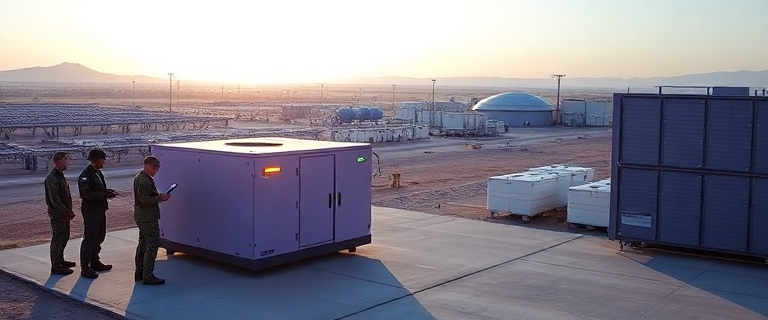
FORTRESS: Keeping U.S. bases operational for 90 days without outside power
The Pentagon is advancing a plan—FORTRESS—to ensure every major U.S. military installation in the continental United States can sustain essential operations for at least 90 days without relying on outside power or supply chains. This effort reflects a broader shift in how the military prepares for warfare that could cripple civilian infrastructure and disrupt logistics, communications, and manufacturing that support national defense.
Why a 90-day self-sufficiency standard matters
The core idea is straightforward: in a major conflict, the civilian grid and supply networks may fail or become unreliable, leaving bases without vital resources. As Pentagon spokesman Sean Parnell puts it, “Power is combat now. Without electricity, you lose communications, water, logistics, assembly lines and just basic military command structures.” This reflects the belief that maintaining military readiness requires bases to operate independently of civilian power networks for an extended period. The argument rests on the risk that relying on civilian infrastructure could become an intolerable vulnerability during a large-scale war.
Origins, leadership, and official backing
The initiative was unveiled as part of a broader effort to harden U.S. defenses against disruptions to energy and critical supply chains. Defense Secretary Pete Hegseth introduced FORTRESS in his September 30 State of the Force address, underscoring the push to have major installations generate their own power and reduce dependence on civilian systems. A subsequent memorandum established a dedicated program office to guide the effort, signaling formal DoD sponsorship and ongoing project management. Pentagon spokesperson Sean Parnell, who leads the FORTRESS effort, has framed the plan as a necessary evolution in homeland defense thinking.
What FORTRESS envisions: technologies, resilience, and pathways
At its core, FORTRESS contemplates technologies that can keep bases supplied with electricity, water, fuel, and communications even when civilian networks are compromised. The plan envisions portable nuclear reactors, large-scale battery storage, and microgrids capable of disconnecting installations from civilian power networks. This would allow bases to continue operating during prolonged power disruptions and maintain mission-critical functions.
To reduce single points of failure, the initiative requires at least two qualified supply or production pathways for the military’s most critical dependencies. This means that if one factory or supplier is disrupted, others can take up the slack to keep operations running.
Reserves, manufacturing, and continuity planning
FORTRESS expands on the military’s approach to strategic resilience by calling for strategic reserves of munitions, fuel, critical minerals, electronics, spare parts, and medical supplies. The goal is to maintain readiness even if international supply routes are disrupted or domestic manufacturers cannot keep pace with wartime demand. In addition, the plan embraces the Civil Reserve Manufacturing Network, folding it into FORTRESS to identify commercial factories capable of shifting to defense production during a crisis. The process involves establishing technical specifications, cybersecurity protections, contracting arrangements, and conversion procedures in advance so production can ramp up quickly when needed.
To test and strengthen this resilience, FORTRESS prescribes recurring industrial stress tests and mobilization exercises to verify that manufacturers can sustain production through prolonged disruptions. In parallel, the effort aims to strengthen military communications, navigation, and space-based capabilities so operations endure even if some assets face interference or disruption.
The threat context and strategic shift
A central concern driving FORTRESS is the possibility of a future conflict that directly affects the American homeland. The plan reflects a shift away from an assumption that the United States would be protected by two vast oceans and a stable global order. As Parnell has noted, “I realized that a lot of the way we think about homeland defense was built around the antiquated assumption that two oceans would protect us.” This has informed a broader emphasis on Western Hemisphere focus and other steps toward homeland resilience, sometimes described in combination with ideas like Golden Dome and renewed attention to the Western Hemisphere, Greenland, and Panama as strategic considerations.
The initiative also anticipates that major conflicts could disrupt global supply chains for weapons, equipment, and other vital materials. Parnell emphasizes that the next war is likely to involve multiple fronts and stressed that strengthening domestic capabilities reduces the risk of supply-constrained failures that could cripple military operations.
Implementation and scale: five bases and ongoing momentum
One concrete detail is that the Army has moved to advance nuclear microreactors at five bases, a program that includes awards totaling up to about $2.2 billion and references Fort Bragg and Fort Hood among the locations. This illustrates the scale of the effort to diversify and harden power generation for key installations as part of a broader portfolio of resilience measures.
Public messaging: why readers should care
FORTRESS is framed as an insurance policy for the homeland, intended to ensure U.S. armed forces can continue operating even if a major war disrupts infrastructure and supply chains they rely on. The practical implication for readers is that such planning seeks to protect national security interests by reducing dependence on vulnerable civilian systems; in turn, it signals a broader trend toward more robust civilian-military cooperation in resilience planning, even as the primary focus remains on defense operations.
Conclusion: a formal, urgent, and forward-looking program
FORTRESS represents a formal DoD program with high-level backing, aimed at securing a 90-day self-sufficiency standard for major U.S. bases. By integrating advanced energy technologies, diversified supply pathways, strategic reserves, and a mobilization-focused manufacturing network, the Pentagon seeks to ensure continuity of military operations in the face of potential disruptions to power and supplies. The emphasis on proactive planning and resilience—emphasizing the safety and effectiveness of forces under challenging conditions—conveys a clear editorial point: in an era of amplified threats to critical infrastructure, homeland readiness begins with the bases that defend it.