
The Colossal Statue of Ramesses II: Discovery, History, and Significance
The monumental Ramesses II statue speaks to an ancient program of building and imperial image-making. It combines two-tone stone sculpture, rich inscriptions, and a journey from Thebes to London that helped shape modern Egyptology. Recent discoveries at Behbeit El-Hagar add new layers to our understanding of Ramesses II’s building projects in the Delta and the statue’s enduring cultural resonance.
What is the statue of Ramesses II?
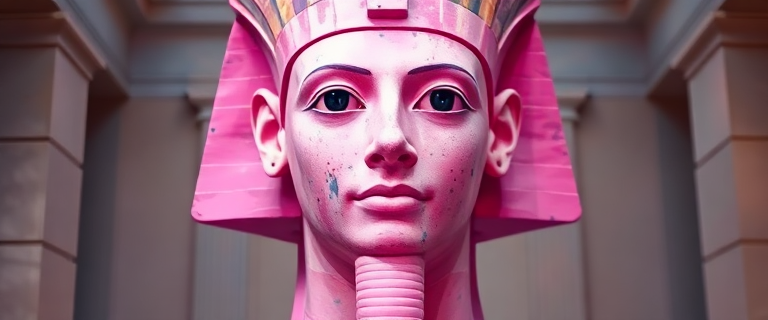
The colossal statue represents Ramesses II, the New Kingdom pharaoh who reigned for about 66 years between 1279 and 1213 BCE and is commonly called Ramesses the Great. The figure is presented in an idealized, youthful form, bare-chested and wearing a striped headcloth and royal crown. The surviving head and torso were once part of a larger seated statue, which was damaged in later periods and is now split between sites.
The statue was cut from a single block of two-tone granite and granodiorite—two of Egypt’s hardest and most prized stones. The lighter pink granite was used for the face and crown, while a darker stone forms the base, creating a striking contrast. The deep, dark stone is said to evoke the fertile black soil of Egypt, while the pink granite carries solar associations. Traces of blue and yellow on the headdress, red on the skin, and black in the eyes reveal that the statue was originally vividly painted.
Beyond its beauty, the statue functioned as a cult statue—a living image intended to house the pharaoh’s ka, or life force. In that role, offerings could be made and rituals conducted to sustain Ramesses II’s spirit. This purpose helps explain why the statue was kept in such a prominent, sacred position and why its imagery was reinforced through inscriptions and paint.
The statue’s enduring presence in modern museums continues to illuminate ancient beliefs about kingship, divinity, and public ritual.
For readers curious about terminology, the statue’s name in modern memory is influenced by the ancient site’s classical name Memnonium. The Ramesseum’s monument, where the figure originally stood on Thebes’s West Bank, is also tied to the name “Younger Memnon” in reference to the younger of the two colossal Ramesses II figures that stood at the temple entrances.
Where was it found?
The statue originally stood in the Ramesseum, Ramesses II’s memorial temple on the West Bank at Thebes (modern Luxor). Facing the Nile and opposite the great temples of Karnak and Luxor, the Ramesseum was designed as a monumental residence for the king in the afterlife and in worship, often described as the pharaoh’s “mansion of millions of years.”
The statue formed the southern end of a pair that flanked one of the central entrances to the complex. The head of the northern statue still lies at the Ramesseum site, while the base of the statue now at the British Museum was re-erected there in the 1990s. Classical informants noted the Ramesseum as Memnonium, which is why the British Museum statue is sometimes referred to as the “Younger Memnon.”
How big is the statue and how much does it weigh?
Even in its incomplete state, the seated figure is colossal. From the headdress to the chest, it measures just over 2.5 metres high and spans more than 2 metres across the shoulders, weighing around 7¼ tonnes. In its full form, the statue would have stood roughly 7 metres tall and weighed an estimated 20 tonnes, a scale few ancient sculptures rival.
What are the inscriptions on the Ramesses II statue?
Inscriptions on the back pillar and throne proclaim Ramesses II’s royal titles and his divine connection to Amun-Ra, king of the gods. One high-ranking inscription offers a royal formula describing him with titles such as Usermaatra-Setepenra, son of Ra, Ramesses-Meryamun, beloved of Amun-Ra. A fragment spoken by Amun-Ra himself declares: “O my son, of my flesh, my beloved, Ramesses-Meryamun! I have given you millions of years, hundreds of thousands of jubilees, and all foreign lands are under your soles.” On the throne, scenes show the Nile’s floodwaters binding lotus and papyrus—symbols of Upper and Lower Egypt—emphasizing Ramesses II’s rule over a united land. These inscriptions not only identify the statue’s sacred role but were believed to grant the pharaoh eternal life through the continual repetition of his names.
Who created the Ramesses II statue?
Creating this statue would have required several specialized teams. Sculptors carved the form from a single block of two-tone granite and granodiorite quarried near Aswan, about 200 kilometres south of Thebes, using hard stone hammers and copper or bronze chisels. Once shaped, the block was moved onto wooden sledges, transported by river to Thebes, and then carved with fine details before polishing and painting. The result was a gleaming, monumental image intended to project divine kingship as worshippers approached the temple gates and approached the statue—an enduring symbol of Ramesses II’s authority.
How did Ramesses use the statue to show his power?
Ramesses II leveraged monumental sculpture to project political and spiritual power beyond his lifetime. The statues served as fixed embodiments of the pharaoh’s divine spirit, designed to greet worshippers and protect sacred spaces at temple gateways. They presented the king as both a human ruler and a god-king, a visual assertion of unity and strength for Upper and Lower Egypt alike. Ramesses’s ambition extended beyond Thebes, with monumental columns and figures at Abu Simbel and other sites illustrating a broad, imperial building program that projected his rule across the empire. The inscriptions and lifelike portrayal reinforced his identity as a powerful, enduring authority.
Did the Ramesses II statue inspire the poem Ozymandias?
Yes—indirectly. The ancient historian Diodorus Siculus records an inscription at the Ramesseum that reads: “I am Ozymandias, king of kings; if any one wishes to know what I am and where I lie, let him surpass me in some of my exploits.” The Greek name “Ozymandias” derives from Ramesses II’s throne name, Usermaatra. This lineage likely inspired Percy Bysshe Shelley’s 1817 sonnet Ozymandias, which reflects on the transitory nature of earthly power. Shelley may not have seen the statue itself, but news of the Younger Memnon’s discovery and journey to Britain circulated widely, prompting contemporaries to respond with poetry that echoed the statue’s themes of decay and hubris. Today, the poem’s “shattered visage” and the statue’s ruins resonate together as a tangible echo of ancient ambition and modern reflection.
Coloured lithography and contemporary illustrations from the period capture the statue’s journey and the cultural fascination it inspired, reinforcing the interplay between discovery, interpretation, and art.
From Thebes to London: How the Museum acquired the statue
The head of the Ramesses II statue began its journey in 1816, when the British Consul in Egypt, Henry Salt, and his agent Giovanni Battista Belzoni—the famed circus strongman—removed the head, which lay partly buried in sand. Belzoni organized local labor, used wooden sledges, and dragged the heavy block to the Nile’s edge, loading it onto a barge and transporting it to Alexandria, then onward to Malta and London. The head arrived in 1818, and the statue was installed at the British Museum in 1819 with the help of the Royal Engineers, becoming one of the museum’s most celebrated exhibits. While modern readers may view these early acquisitions with scrutiny, they marked a turning point in Western engagement with Egyptian art and helped establish the field of Egyptology as a serious scholarly pursuit.
Where is the Ramesses II statue now?
The colossal head has stood in the British Museum’s Egyptian sculpture gallery (Room 4) since 1819. Its placement in the gallery—approximately at the height it would have occupied at the Ramesseum—offers visitors a direct sense of the statue’s original scale and presence. The head’s gaze and serene expression continue to convey a sense of divine majesty that once greeted worshippers at Thebes.
Modern discoveries at Behbeit El-Hagar and related context (2026)
Archaeologists working at Behbeit El-Hagar uncovered remains that include a pink inscribed stone and the remains of two colossal Ramesses II statues. A farmer, Khaled al-Shahat, found the pink inscribed stone while working on his land and reported it to authorities, triggering the investigation and subsequent discoveries. The team recovered a five-foot-tall head believed to have topped one statue. Based on the head’s size, officials estimate that the full statue, including the base, may have stood nearly 28 feet tall. A second statue fragment, though missing its legs and base, includes a head wearing the nemes and a section of the back pillar bearing one of Ramesses II’s royal titles, “Hor Ka Nakht Mery-Maat.” The surviving fragment, excluding the legs and base, is almost eight feet high and may also represent Ramesses II. A pink granite block found nearby bears two royal titles: “Nesw-Bity” (King of Upper and Lower Egypt) and “Sa-Ra” (Son of Ra).
The Behbeit El-Hagar site is best known for a temple dedicated to the goddess Isis, built largely under Nectanebo II and later completed under Ptolemy II and Ptolemy III. The Ramesses II fragments were found on the western side of the temple complex, illustrating that Ramesses II undertook major building works at this Delta site long after the temple’s initial construction. This context helps explain why Ramesses II’s sculptures appear at a site associated with a later temple and underscores the broader scope of his building program.
Symbolic material interpretation also adds depth: the dark stone likely evokes the fertile black soil of Egypt, while the pinkish granite resonates with solar associations, enriching the aesthetic and symbolic reading of the works. The discovery suggests that Ramesses II’s influence extended beyond Thebes into multiple centers, reflecting a coordinated empire-wide cultic and commemorative program.
For readers curious about nomenclature and geography, the Behbeit El-Hagar discoveries connect to the broader story of the Ramesseum and the Younger Memnon, including the fact that previous excavations in 2017 uncovered two architectural fragments bearing Ramesses II’s name, reinforcing the pattern of Ramesses II-related finds at the site. The base of the northern statue remains at the Ramesseum, while the British Museum’s statue base was re-erected there in the 1990s, linking the British and Egyptian contexts in a continuous historical narrative. The broader story also references the Ramesseum’s classical name Memnonium, which explains the nickname “Younger Memnon” for the British Museum statue.
Why these discoveries matter for readers
Together, the ancient statue’s craftsmanship, inscriptions, and religious function illuminate how Ramesses II used monumental sculpture to sustain the king’s presence and divine authority. The journey from Thebes to London illustrates the early history of archaeology and museum collecting, while the new Behbeit El-Hagar finds expand our view of Ramesses II’s building program and the empire-wide reach of his monumental imagery. The integration of human-interest elements—such as farmer Khaled al-Shahat’s role in the 2026 discoveries—helps ground the narrative in real-world recent events, increasing reader engagement and trust.
Quick notes on related terms and context
The Younger Memnon nickname derives from the classic Memnonium name for the Ramesseum. The statue’s base at the British Museum and its companion base at the Ramesseum tie together the local archaeological landscape in Egypt with a global museum collection. The statue’s two-tone composition—pink granite for the face and lighter granite for the crown against a darker base—along with the painted traces, convey both a vivid visual identity and a durable architectural ambition that was meant to endure across centuries.
Conclusion: enduring significance
Ramesses II’s colossal statue remains a powerful symbol of ancient Egyptian kingship, artistry, and ritual life. Its journey—from the sands of the Ramesseum to the British Museum—alongside ongoing discoveries at Behbeit El-Hagar, continues to shape our understanding of Ramesses II’s monumental program and the ways in which modern audiences connect with those ancient works. The statue’s inscriptions, discoveries, and the site’s broader temple history together offer a rich narrative about power, religion, and cultural memory that readers can explore with curiosity and care.