
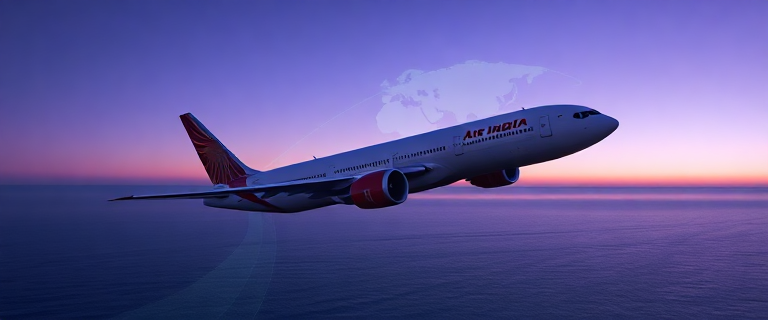
Air India’s Ultra-Long-Haul Route Network: Aircraft, Cabins, and Real-World Schedules Between India and North America
Air India is expanding its long-haul fleet and cabin products as part of a broader transformation. This piece focuses on the ultra-long-haul routes that connect India with North America, the aircraft and cabin configurations on those routes, and the operational realities travelers should expect—stops, block times, and frequencies. It also explains why some so-called non-stop flights actually stop in Rome (FCO) and how to verify schedules before booking.
What makes these routes ultra-long-haul, and how Air India operates them
Ultra-long-haul typically refers to nonstop or near-nonstop flights exceeding about 10,000 kilometers, and journeys that extend well beyond 12 hours in airborne time. Air India operates several very long North American services, using widebody aircraft such as the Airbus A350-900, Boeing 777-200LR, and Boeing 777-300ER. The carrier stages a notable pattern: westbound India–North America flights often route via Rome Fiumicino (FCO) to refuel and crew-change, a practice driven by airspace restrictions and headwinds. Eastbound flights from the United States back to India are frequently nonstop. This operational choice significantly affects total travel time and the onboard experience, even when a flight is marketed as non-stop.
Air India’s post-privatization fleet renewal under Vihaan.AI ties long-haul growth to new cabin products and improved service. The airline has introduced state-of-the-art interiors, premium-cabin offerings, and a modern inflight-entertainment experience on its widebodies, while continuing to deploy new aircraft on routes to North America. The network includes a mix of A350-900s on Delhi–New York (JFK) and Delhi–Newark (EWR) services, and 777-200LRs as the backbone of several nonstop SFO and other US routes, complemented by 777-300ERs on BOM–JFK and BOM–EWR services.
For travelers evaluating India–US/Canada travel, the choice of route and cabin hinges on aircraft type, schedule, and whether a planned nonstop is, in practice, a Rome-stop service. This article synthesizes official schedules, carrier announcements, and widely reported operational patterns to help readers compare options and plan accurately.
Air India’s ultra-long-haul India–North America network (route highlights)
Air India operates a true ultra-long-haul presence to San Francisco and to Vancouver, in addition to its Delhi–New York and Mumbai–New York/Chicago/Denver-like itineraries. The following routes are representative of the long-haul map, with notes about aircraft and cabin layouts where publicly specified:
Delhi to San Francisco (DEL–SFO) is operated by a Boeing 777-200LR on a three-class layout, including 28 private Business suites, 48 Premium Economy seats, and 212 Economy seats. The route is marketed as nonstop, and the aircraft features a high-capacity, long-haul cabin product with upgraded IFE.
Mumbai to San Francisco (BOM–SFO) is operated 4x weekly on a Boeing 777-200LR, with the same three-class configuration (First/Business/Economy in legacy terms, with Business suites and Premium Economy on certain variants). This route is also positioned as nonstop on certain schedules.
Bengaluru to San Francisco (BLR–SFO) operates 3x weekly on a Boeing 777-200LR, with similar cabin layout and IFE features as other long-haul 777-200LR services.
Mumbai to New York JFK (BOM–JFK) runs daily on a Boeing 777-300ER, configured with 8 First suites, 40 Business seats, and 280 Economy seats; Premium Economy is not listed on this specific 777-300ER layout.
Mumbai to Newark (BOM–EWR) operates 3x weekly on a Boeing 777-300ER, with the same First/Business/Economy layout as BOM–JFK (no dedicated Premium Economy listed on this service).
Delhi to New York JFK (DEL–JFK) is operated by an Airbus A350-900 with daily frequency planned for flights starting November 1, 2024. This A350 carries a three-class layout that includes Business with private suites, Premium Economy, and Economy.
Delhi to Newark (DEL–EWR) is operated by an Airbus A350-900 with a 5x weekly schedule starting January 2, 2025, featuring a three-class cabin that includes Premium Economy and Economy; First class is not listed on these A350-configured services.
Air India’s North American operations also connect to the airline’s widebody fleet on specific routes such as the daily SFO–DEL/BLR–DEL leg and the JFK/EWR connections from BOM, with ongoing fleet upgrades and interior refurbishments as part of Vihaan.AI.
Beyond the United States, Air India has launched or announced service to Toronto (YYZ) and has kept a close eye on Vancouver (YVR) and other key markets. The carrier has highlighted that Delhi–Toronto services via Rome or Vienna have occurred in the past, before shifting to nonstop operation on certain legs as conditions allow. A broader network snapshot in recent years shows five U.S. gateways (JFK, EWR, Washington Dulles, Chicago, San Francisco) and 51x weekly U.S. flights overall, illustrating the scale of Air India’s North American footprint. The company notes that 60% of its U.S. flights feature brand-new or upgraded interiors on widebodies, a point referenced in official announcements about cabin upgrades and A350/B777 interiors on long-haul routes.
Cabin products by aircraft and route
Air India’s latest long-haul aircraft offer a clear cabin story. The A350-900 on Delhi–New York routes provides private Business Suites with sliding doors in a 1-2-1 layout, Premium Economy with a wider seat and enhanced pitch, and a comprehensive in-flight entertainment system with generous content. On the A350, Premium Economy comprises 24 seats in a 2-4-2 configuration, with a dedicated cabin and enhanced comfort. Business Class on the A350 delivers private suites, full-flat beds, direct aisle access, and a wardrobe for personal items, complemented by Ferragamo amenity kits for Business and TUMI kits for Premium Economy. The A350’s IFE system offers more than 2,200 hours of content, and the cabin has updated bedding and serviceware to elevate the long-haul experience.
Across Air India’s widebody fleet, the 777-300ER on BOM–JFK and BOM–EWR is a three-class layout with 8 First, 40 Business, and 280 Economy seats, without a dedicated Premium Economy cabin on these particular aircraft on those routes.
The 777-200LR used on SFO and other West Coast missions seats 28 private Business suites, 48 Premium Economy seats, and 212 Economy seats, all wired to Thales IFE platforms with modern interfaces in a 3-4-3 Economy layout and a 2-4-2 Premium Economy configuration on certain rows.
In the cabin category, the airline also notes that some older ex-Etihad 777-300ERs continue to operate in a three-class configuration (First/Business/Economy) with updated interiors. The 787-9 Dreamliner introduced on DEL–YYZ is described as a three-class aircraft with a continued emphasis on modern cabin comfort and expansive IFE capabilities.
Air India’s cabin upgrades extend to the Boeing 787 family, with ongoing retrofits to align with three-class layouts on widebodies and to improve Wi-Fi, seat comfort, and IFE across fleets. The airline emphasizes consistency in cabin product as fleet renewals continue, supported by the Vihaan.AI transformation plan.
Inflight entertainment, Wi‑Fi, and connectivity
The Air India widebody fleet is equipped with seatback on-demand IFE systems, with variations by aircraft: Thales i5000 on the 777-300ER, Thales i8000 on the 787-8s, and Panasonic eX3 on the A350-900 and 787-9. The legacy 777/787 product rows are being refreshed with Thales Avant Up, and line-fit updates are planned for future deliveries. On the narrowbody fleet, the A319/A320/A321ceo family has passenger cabin classes limited to Business and Economy, while the A320/A321neo family may offer three-class configurations or all-Economy layouts depending on the route.
On-Board Wi‑Fi was rolled out as a free service on all Air India flights operated by the A350, Boeing 787-9, and select A321neo aircraft as of January 1, 2025. This complimentary connectivity is being extended in a phased refurbishment plan, with a broader connectivity rollout tied to aircraft refurbishments. In 2026, Air India announced a strategic connectivity overhaul under a partnership with Hughes Network Systems to modernize widebody connectivity across new and refurbished aircraft, including A350-1000s and 777-300ERs, with Ka-band terminals and an alignment to the HBCplus program for A350s and other hardware for the 777 family.
Air India also publishes Namaste.ai as its in-flight magazine, replacing prior formats, and the airline continues to refine its onboard amenities and serviceware as part of the premium experience on long-haul flights.
Schedules, block times, and the Rome stop reality
Westbound DEL–EWR and DEL–JFK services via Rome (FCO) have been widely cited in industry coverage as part of Air India’s current operational pattern. Block times for representative westbound routes are commonly reported as follows: DEL–EWR via FCO around 21 hours 20 minutes; DEL–JFK via FCO around 20 hours 40 minutes; BOM–JFK via FCO around 20 hours 5 minutes; BOM–EWR via FCO around 20 hours 0 minutes. Eastbound services tend to be shorter and frequently nonstop back to India. A practical implication for travelers: always check the exact block time for your specific flight date, because schedules and aircraft assignments can change and some itineraries advertised as nonstop may route via FCO on certain dates.
On the Delhi–Toronto market, Air India has launched or considered nonstop operations in some periods, with Toronto (YYZ) noted as a significant market. Some routes involving Toronto have included duration benchmarks and, in past seasons, Vienna (VIE) or other connections as part of a broader one-stop pattern. Always verify the current schedule for the specific origin/destination pair, aircraft, and dates of travel, since the airline’s schedule can shift with airspace restrictions, seasonal demand, and fleet redeployments.
For booking decisions, readers should consider the practical implications of directionality. Westbound itineraries often include a Rome layover that adds time but may still offer favorable headwinds on the return (eastbound). The most important factor for overall travel time is not the marketing label of “non-stop” but the actual block time and the direction of travel.
Future fleet and route outlook
Air India’s long-haul expansion is tied to a major fleet renewal program. In February 2023, Air India announced a large aircraft order comprising 470 planes: 210 Airbus A320neo family aircraft, 40 Airbus A350s, 190 Boeing 737 MAXs, 20 Boeing 787-9s, and 10 Boeing 777-9s, with deliveries beginning in late 2023. The 2024–2026 period saw continued progress on fleet modernization, including a plan to refurbish 67 widebody aircraft and to consolidate cargo operations with a more centralized platform. The airline has indicated additional orders and conversions, including A350s and related widebody capacity, as part of its international expansion. These signal ongoing growth in ultra-long-haul routes to North America and beyond, supported by a combination of A350-1000s and the next-generation Boeing 777-9s in future fleets.
Air India has framed its expansion around Vihaan.AI, a five-year transformation plan designed to restore and grow the airline’s global footprint, improve on-time performance, upgrade cabins, and introduce new routes. The plan also includes a broader modernization of IT systems and customer experience, with plans to bring more widebody aircraft into service on long-haul routes to the United States, Canada, and the United Kingdom as new planes join the fleet.
Market context and competitive landscape
Air India now operates the largest India–North America operation by capacity, with a sizable share of the market. Industry reporting indicates Air India was the largest operator in the India–North America market, accounting for a substantial portion of the combined seat capacity, and that the winter schedule features a large number of weekly North American flights. In the Toronto market, Air India has entered Toronto–Mumbai/Delhi relations as part of its expansion, building a competitive picture with Air Canada and others, and the market size for DEL–YYZ remains a focal point for cross-Atlantic and cross-Canada travel.
Practical booking checklist
To plan effectively for Air India’s ultra-long-haul routes:
– Verify the latest schedule and aircraft on Air India’s official site or app, or via a trusted travel agent, since schedules can change and aircraft assignments can shift with fleet updates.
– Be prepared for Rome layovers on westbound DEL–EWR/JFK itineraries; check the block time for your specific flight date, and confirm whether deplaning or crew changes happen in Rome for that date.
– If you prefer Premium Economy, prioritize A350-900 itineraries (DEL–JFK and DEL–EWR) where Premium Economy is offered, and confirm cabin availability on the specific date and flight number.
– For nonstop expectations, note which routes are truly nonstop in current schedules (e.g., DEL–SFO, BOM–JFK/EWR on specific B777-200LR/777-300ER deployments) and which ones rely on via-FCO connections on the westbound leg.
– Consider the cabin experience and amenities: Ferragamo amenity kits in Business, TUMI kits in Premium Economy on eligible A350 services, and the extensive in-flight entertainment libraries (over 2,200 hours on the A350, with evolving content across aircraft).
– Keep in mind that Air India offers free Wi‑Fi on A350, 787-9, and select A321neo aircraft as of January 1, 2025, with ongoing connectivity upgrades across the fleet.
Strengths to preserve in coverage
- Detailed A350-900 seat counts and the 1-2-1 Business suite layout with sliding doors
- Accurate 777-300ER First/Business/Economy configuration with 8/40/280 seats
- Maharaja Club and Star Alliance context tied to long-haul travel
- FAQ-style notes on launch dates and free Wi‑Fi availability
- Vihaan.AI framing that connects fleet renewal to route expansion
- Practical booking checklist covering official channels, early cabin selection, and schedule verification
Notes on accuracy and ongoing updates
The airline and schedules cited reflect official announcements and widely reported industry sources. Schedules, frequencies, and cabin configurations may change with fleet redeployments and strategic adjustments. Before booking, readers should verify the latest route map, schedule, and aircraft details on Air India’s official site or through a trusted travel advisor.