
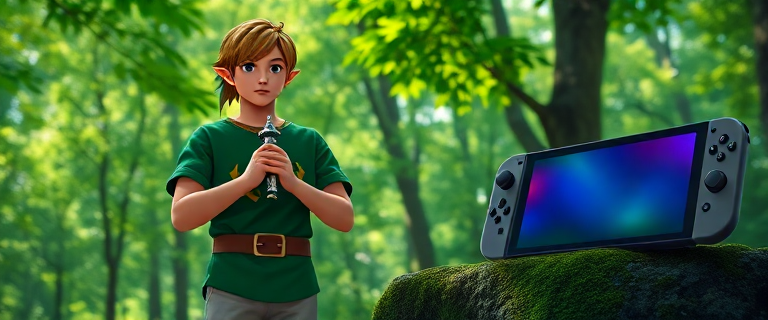
Does The Legend of Zelda: Ocarina of Time Remake Use NVIDIA DLSS?
Nintendo’s Legend of Zelda: Ocarina of Time remake for Nintendo Switch 2 has become a focal point in discussions about upscaling technology. Recent licensing data suggests the game uses AMD FidelityFX Super Resolution 1.0 (FSR 1.0) and SMAA for anti-aliasing, rather than NVIDIA’s DLSS. The final upscaling pipeline remains officially unconfirmed, and Nintendo has not publicly detailed the rendering workflow. The release is planned for November 5, 2026, exclusively on Switch 2, with digital and physical editions priced at $59.99 and $69.99 respectively. Independent previews indicate strong performance, but the exact internal rendering resolution and modes are still under scrutiny.
What the licensing data actually shows about upscaling
The licensing information surrounding the remake lists AMD FidelityFX Super Resolution 1.0 as part of the software package, along with SMAA for anti-aliasing. There is no entry for NVIDIA DLSS in the observed material. Importantly, the presence of FSR 1.0 does not prove that DLSS is never used. Licensing disclosures confirm what components are included but do not reveal how they are applied in every display mode or whether a day-one patch could alter the pipeline. Nintendo has not officially confirmed the final upscaling method or the rendering pipeline, so the absence of a DLSS entry is not a definitive denial of its use in some capacity.
The discovery originated from a post by SuperMetalDave64 on X, who shared footage of the game’s intellectual-property notices for version 1.0.0. This attribution matters because it provides a verifiable source for readers who want to verify the licensing details themselves. Still, licensing data alone cannot establish the exact in-game behavior, and, as with any leak, readers should treat it as a piece of the puzzle rather than a final verdict.
Why fans say it looks like DLSS, and what that means
Across fan discussions, many people point to visuals that resemble what they associate with DLSS—especially the sharpness and perceived stability of details in complex scenes. A practical way to understand this is to consider how the combination of sharpening from FSR 1.0, a highly realistic art direction, and modern lighting can produce an image that appears to have AI-assisted reconstruction. In other words, even without DLSS, the overall presentation can evoke the look fans expect from a DLSS-driven upscale. It’s important to note that this is a visual impression driven by rendering approaches and design choices, not a confirmation that DLSS is active across all modes.
Licensing data on its own cannot resolve this ambiguity. The strongest evidence, to date, points toward FSR 1.0 as the chosen upscaling component, but Nintendo has not disclosed the exact pipeline. The absence of a DLSS entry in the license file does not definitively rule out DLSS usage in any mode or patch; it simply means the public licensing material does not list DLSS as part of the shipped package.
Performance signals: 60 FPS and 1080p
Early hands-on previews paint a compelling picture of performance. Independent testers report 60 frames per second, a significant improvement over the original Nintendo 64 title’s 20 FPS. Digital Foundry’s analysis of Nintendo’s gameplay footage suggests rendering at approximately 1080p at 60 FPS, delivering a smoother and more detailed experience. These impressions are encouraging for players who value responsiveness in combat and exploration, even if the exact upscaling method remains officially unconfirmed.
What Switch 2 features are part of this remake
The remake is described as a complete visual and mechanical reimagining of the 1998 classic, featuring redesigned environments, voiced cutscenes, and modernized controls. In addition, Nintendo highlights a full 360-degree camera movement and support for playing Link’s ocarina through the Switch 2’s built-in microphone. These enhancements contribute to the perception of a “new” presentation while preserving the core narrative and dungeon layout of the original.
Does the absence of DLSS really matter?
Does the lack of DLSS pose a practical drawback? Based on early impressions and the available reporting, it appears the answer is likely no for this specific title. The combination of a targeted 60 FPS goal, the use of FSR 1.0 with sharpening, and the overall quality of the upscaled output seem to deliver a clean, sharp image without compromising the experience. Any shimmering or minor artifacts described by observers are typical of spatial upscaling approaches and do not fundamentally undermine gameplay. Nintendo’s choice may be influenced by licensing considerations, performance predictability, and alignment with the platform’s hardware strategy, rather than a direct measure of image fidelity alone.
That said, the licensing evidence does not close the door on DLSS entirely. It is possible that some modes, patches, or future updates could introduce or enable DLSS in a post-launch context. Until Nintendo confirms the final rendering pipeline, readers should treat the current information as indicative rather than definitive.
New features and the broader technical package on Switch 2
In addition to upscaling considerations, the remake’s Switch 2 feature set includes notable mechanical and audiovisual improvements: redesigned environments, voiced cutscenes, and modernized controls, with a 360-degree camera and the ability to use the ocarina via the console’s built-in microphone. These elements contribute to a more immersive experience and are integral to the “Switch 2 features” narrative surrounding the game. While DLSS remains unconfirmed, these enhancements collectively elevate the game beyond a simple remaster, aligning it with contemporary expectations for a full-spectrum remake on Nintendo’s newest hardware.
Release details
The Legend of Zelda: Ocarina of Time remake launches exclusively on Nintendo Switch 2 on November 5, 2026. The digital edition is priced at $59.99 in the United States, while the physical edition carries a regular price of $69.99. For readers seeking the latest visual comparisons and feature explanations, a detailed Zelda: Ocarina of Time remake versus original comparison guide is available as a reference point.
Credibility and caveats
Readers should note that licensing data provides a partial, not final, view of the rendering pipeline. The discovery reported by SuperMetalDave64 on X identifies a licensing list that includes FSR 1.0 and SMAA but omits a DLSS entry, and Nintendo has not issued a formal statement about the upscaling method. Independent hands-on previews and Digital Foundry analyses contribute valuable performance signals, but questions about the exact internal workflow remain until official confirmation. Until then, the consensus is that FSR 1.0 is the most strongly supported conclusion by the available public information, with the caveat that the door remains open for further clarification post-launch.
As the release approaches, expect ongoing discussion about how these decisions influence image quality, performance, and overall player experience. The strongest practical takeaway is that the remake delivers a smoother, more visually rich experience than the original, with 60 FPS gameplay and 1080p rendering signals supported by credible early testing, even if the precise upscaling method isn’t publicly spelled out yet.