
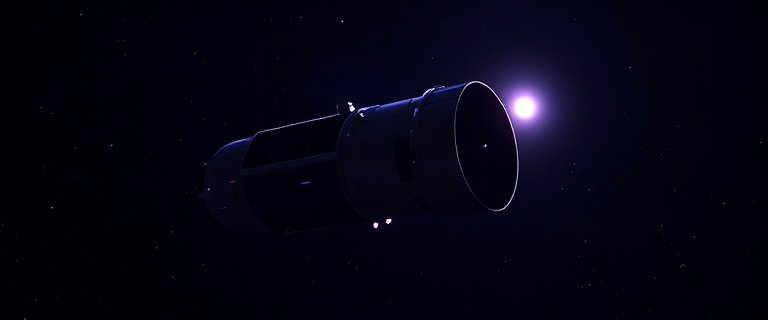
Voyager 1: October 2026 signal pause, an autonomous fault-protection comeback, the Big Bang power swap, and the one-light-day milestone
In October 2026, NASA’s Voyager 1 briefly went quiet, pausing communications for about 48 hours. The episode ended with the spacecraft resuming contact on October 20, and engineers later explained that the event was resolved by the spacecraft’s own fault-protection safeguards before any ground-issued commands were sent. Against the backdrop of aging RTG power and the need to keep essential science alive, NASA’s team had just completed a months-long energy-saving effort nicknamed the Big Bang, swapping six devices for lower-power equivalents to stretch power into the mission’s final years. All of these elements—the autonomous recovery, the power-management maneuver, and the looming one-light-day distance—shape Voyager 1’s evolving story as it journeys through interstellar space.
The October 2026 outage: what happened and how Voyager recovered
Between October 18 and 19, 2026, NASA’s Deep Space Network could not detect Voyager 1’s radio signal during two scheduled communication attempts spaced 24 hours apart. The probe sits roughly 16 billion miles (about 24 billion kilometers) from Earth, a distance that makes real-time dialogue with the probe inherently challenging. The signal reappeared on October 20, and since then Earth control has maintained communication with Voyager 1. Importantly, the outage did not require an engineer-led recovery: the fault-protection system automatically redirected the spacecraft to a safe configuration when one thruster group went offline and backups activated. This autonomous response paused normal operations to protect the spacecraft and allow time for diagnosis, after which the link was restored without ground intervention. Kareem Badaruddin, Voyager mission manager at NASA’s Jet Propulsion Laboratory, summed up the moment: “This is the first time we’ve seen the spacecraft do something like this, but we are also at a point in the mission where we have to expect the unexpected… We’re relieved to be back in contact with Voyager 1 and are eager to understand what happened.”
In practical terms, the incident showed the fault-protection logic at work: if active thrusters are detected as offline or misbehaving, the spacecraft automatically switches to backup thrusters and pauses nonessential operations to maintain stability. The two-day pause was unusual in its duration, but the behavior—the spacecraft taking autonomous action to preserve itself and then restoring contact—fits the mission’s long-standing emphasis on fault tolerance as a core operating principle in the face of harsh, remote-space conditions.
The Big Bang: a months‑long plan to stretch diminishing power
Power for Voyager 1 and its twin comes from radioisotope thermoelectric generators (RTGs), which convert heat from decaying plutonium into electricity. As the plutonium decays, the power margin shrinks by about 4 watts per year. With decades of distance and aging hardware, mission teams must conserve energy by turning off nonessential devices while keeping the spacecraft warm enough to function in the cold depths of space. In early September 2026, engineers completed a coordinated energy-saving maneuver nicknamed the Big Bang. Six devices—three warming devices and three lower-power substitutes—were swapped to reduce overall power use while preserving heat distribution across the spacecraft. The swaps had to be done simultaneously to ensure heat remained evenly distributed and the spacecraft stayed warm enough for ongoing operation. The result is a slower drain on the RTG and extended life for the remaining operational systems.
Two science instruments have already been turned off in recent years to extend the mission’s life, underscoring the trade-offs involved in keeping Voyager 1 alive as it travels through interstellar space. The Big Bang is designed to preserve the instruments most vital to its ongoing science goals: the Cosmic Ray Subsystem, the Magnetometers, and the Plasma Wave Subsystem. Specifically, the strategy aims to keep these three instruments powered so they can continue to collect data on high-energy particles, the local magnetic field, and ripples in charged gas around the spacecraft. This careful selection—keeping high-value instruments online while trimming power-hungry subsystems—helps Voyager 1 continue functioning even as RTG power fades. As NASA noted, without the Big Bang, one more instrument would have needed to be shut off by summer 2027, illustrating how close the mission is to the practical limits of power availability.
The one-light-day milestone: what it means for distance and communication
As the mission approaches a distance of one light-day from Earth, Voyager 1 is traveling at about 38,000 mph (61,155 kph). Entering interstellar space in 2012, Voyager 1 remains the first and farthest human-made object to venture beyond the heliosphere—the Sun’s protective bubble of particles and magnetic fields. When Voyager 1 crosses the one-light-day threshold on November 18, 2026, light itself will take 24 hours to reach the spacecraft, and any reply would take another 24 hours to return. Suzanne Dodd, project manager at JPL, captures the practical reality of this distance: “If you want to say ‘hello’ to Voyager, you send your message and then you go home and you wait two days before you finally get a response.” The milestone isn’t about dramatic changes aboard the spacecraft; instead, it underscores the vastness of space and the endurance of humanity’s most distant explorer.
What the current status means for Voyager’s future
Voyager 1’s power margins are tightening, but the Big Bang demonstrates a concrete approach to extending the life of the mission. The combination of RTG power decay, heat management, and selective instrument operation means the spacecraft will continue returning data for as long as practical, even as some instruments remain powered down. The ongoing open questions about the exact root cause of the Oct. 2026 thruster anomaly reflect the broader reality of operating in the far reaches of the solar system: the team can monitor and respond, but the environment and aging hardware introduce uncertainty. The upshot is that Voyager 1 will keep reporting as long as its systems remain within functional bounds, with the Big Bang contributing a meaningful extension to this final chapter of deep-space exploration.
In the end, the October 2026 event reaffirms a core principle of the mission: fault protection and autonomous resilience can buy time when direct ground intervention is slow or impractical. The Big Bang power-saving swap embodies a focused engineering effort to maximize scientific return without compromising safety or thermal balance. As Voyager 1 edges closer to the one-light-day mark, its situation remains a thoughtful reminder of both the fragility and the durability of humanity’s most distant sensors—and of the ingenuity that keeps them listening, even after half a century in the void.
For readers seeking a concise takeaway: Voyager 1 demonstrated autonomous fault protection by returning a signal on October 20, 2026, before any ground commands could be issued; the Big Bang energy swap aimed to preserve critical science instruments—Cosmic Ray Subsystem, Magnetometers, and Plasma Wave Subsystem—while reducing overall power use; the mission’s distance means communications will operate with a two-day latency around the one-light-day milestone, underscoring the challenge and wonder of interstellar exploration.